


Australia's BRI train wreck

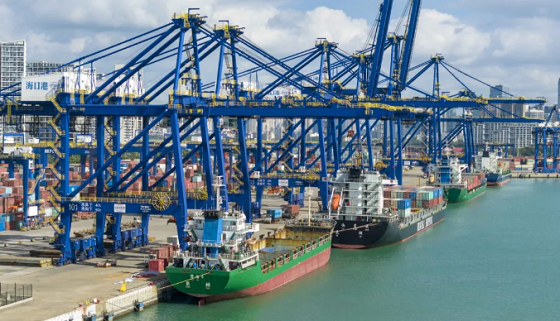
An ocean roll-on ship loads vehicle for export to Australia at the port of Lianyungang Oriental Company in Lianyungang, east China's Jiangsu Province, March 13, 2021. /Getty
Editor's note: Daryl Guppy is an international financial technical analysis expert. He has provided weekly Shanghai Index analysis for media for the Chinese mainland for more than a decade. Guppy appears regularly on CNBC Asia and is known as "The Chart Man." He is a national board member of the Australia China Business Council. The article reflects the author's opinions, and not necessarily the views of CGTN.
There is a certain horrid fascination in watching a train wreck unfold in slow motion. This week the Australian Federal Government over turned the Belt and Road Memorandum of Understanding signed by the State of Victoria with China's National Development and Reform Commission in 2018 and 2019. The arrangements were considered to be "inconsistent with Australia's foreign policy or adverse to Australia's foreign relations."
This diplomatic crash delivers business that same horrid train wreck fascination. Australian business knew this crash was inevitable and they know that just as inevitable is the reaction from China and a further freezing of the Australia-China relationship.
Australia's Foreign Arrangements Scheme introduced in December 2020 gave the Foreign Minister the power to overturn deals with foreign nations.
The rejection of the agreement has three aspects. The first is a domestic political squabble. The federal government and some sections of the media have a deep dislike for the Premier of Victoria, Daniel Andrews. The attack on Victoria's BRI agreement is part of a domestic political quarrel.
The second aspect reflects Australia's national rejection of the BRI. So support for the BRI is cast as being against Australia's interests. The Foreign Arrangements Scheme review process is administered by Australia's Foreign Minister Marise Payne and she and other government colleagues have made clear their opposition to the BRI. For the anti-China group in the Australian Federal parliament this is a longed-for victory.
For Victoria there is a weary resigned acceptance of the inevitable. There was never any doubt that these BRI agreements were the primary political target of the Foreign Arrangements Scheme.
As with many MoU's, Victoria's BRI agreements did not commit the state government to specific projects and is not legally binding. The agreements were about co-operation and it's the rejection of this cooperation with China that is one of the more significant features of this decision.
Some federal government ministers believed the Victorian agreement allowed China to split the domestic consensus the government was trying to build on opposition to the BRI.

Aerial photo shows the Chinese-built Maputo Cross-sea Bridge in Maputo, Mozambique, May 8, 2018. /Xinhua
The third aspect has an international impact. Some believed the Victorian agreement also undermined Australia's attempts to convince other regional countries to tread warily before signing investment deals under the BRI or indeed, in accepting COVID-19 assistance from China.
Of course this advice comes too late as many of the RCEP and ASEAN member countries have already signed BRI agreements and some like Singapore are actively seeking further deeper engagement. Ultimately overturning of the MoU and opposition to the BRI is inconsistent with Australia's desire to play a prominent leadership role in RCEP.
Some observers also noted the timing of the announcement that followed China's Deputy Head of Mission, Wang Xining's remarks at the National Press Club. Echoing the global cooperation and respect themes of Chinese President Xi Jinping's speech at the Boao Forum for Asia, Wang Xining noted that China is open for collaboration and co-operation.
The timing of the Foreign Minister's announcement seemed to be a rejection of this olive branch. In August 2020, immediately following Wang Xining's address which suggested ways Australia-China relations could be improved, Prime Minister Scott Morrison also rejected this goodwill and pledged to tear up state agreements with China.
In the immediate aftermath of this week's announcement, and perhaps keen not to get the national government off-side, some business organisations kept a low profile but this may change as their business members express their growing concerns about the loss of opportunities for involvement in BRI partnerships and the longer term impact on Chinese investment in Australia. Research reports have already shown a 61-percent fall in Chinese investment in Australia.
The Belt and Road Initiative is too large and has too much momentum to be hindered by this Australian decision. China's reaction is understandable, but in the larger scheme of events, this is barely a distraction.
For Australian business the impact is more significant because it makes it more difficult for Australian companies to participate in BRI projects. This decision will further close channels of communication with China and reduce opportunities for Australia to encourage China engagement with the region. It makes Australia less attractive as a location for Chinese investment and that's bad for jobs and the Australian economy.
This is a decision driven by short term domestic political in-fighting and backed by those who have no intention of recognizing China's growth or legitimate place in the global order.
Australia faces a complex environment in relation to its engagement with China and the way China's international role is growing. The mixing of domestic politics with international engagement leads to messy solutions which have ill-considered long term impacts. It's a big decision for Australia, but of less importance to China and the BRI. This is a slow moving crash but the consequences may be much more rapid.
(If you want to contribute and have specific expertise, please contact us at opinions@cgtn.com.)

相关阅读


免责声明:本网站信息仅供一般参考,不构成投资或财务建议。虽力求准确与完整,但不保证信息的准确性、完整性或时效性。投资有风险,决策前请咨询专业独立顾问。使用本网站即视为接受本免责声明。
热门点击
-
- 【澳股聚焦】ASX年内涨幅归零之后 市场在等待什么?
-
- 【异动股周报】NMD首秀飙升 DAL见矿翻番 ALV单日飙200% 资源与生物科技双线爆发
-
- 【异动股】Image Resources(ASX:IMA) : 一家市值3千万的澳洲矿企 手里捏着龙佰集团最想要的下一座矿
-
- 【10.13】今日财经时讯及重要市场资讯
-
- 嘉能可登陆澳交所 三巨头鼎立时代开启 ASX铜矿标的稀缺格局迎破局者
-
- 【10.12】今日财经时讯及重要市场资讯
-
- 中国资本vs澳洲关键矿产博弈观察:兴业银锡与两家ASX小盘勘探股的“恩怨情仇”
-
- 2026年IMARC矿业大会悉尼之约 澳大利亚矿业技术与创新力量的全球汇聚
-
- 【10.14】今日财经时讯及重要市场资讯
-
- Ballard Mining(ASX:BM1)获4500万澳元机构融资支持 Mt Ida金矿资源扩量与开发工程同步推进
-
- 液冷数据中心开发商Firmus澳交所上市在即 揽获OpenAI合同大单
-
- 【10.8】今日财经时讯及重要市场资讯
-
- 【异动股】暴涨逾200% 6百万融资到位 Peter Cook站台 54周股价巅峰过后Mamba Exploration (ASX:M24) Copper Hills历史铜带新钻备受瞩目
-
- 浅层探新、深部升级 Lithium Plus Minerals(ASX:LPM)启动Lei锂项目靶向钻探Lei Primary与Secondary双线测试
-
- Li-S Energy(ASX: LIS)与Safesky签署合作协议 推进锂硫电池应用于战术无人机