


Australia suspended and sidelined

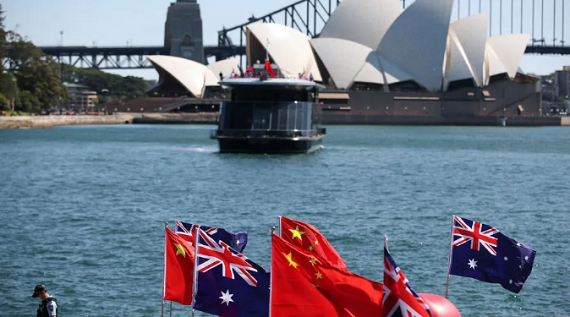
A kayaker paddles past the Sydney Opera House as fog covers the city in Sydney, Australia, December 16, 2020. /Getty
Editor's note: Daryl Guppy is an international financial technical analysis expert. He has provided weekly Shanghai Index analysis for Chinese mainland media for more than a decade. Guppy appears regularly on CNBC Asia and is known as "The Chart Man." He is a national board member of the Australia China Business Council. The article reflects the author's opinions and not necessarily the views of CGTN.
China's National Development and Reform Commission (NDRC) has taken the inevitable step to indefinitely suspend all activities under the China-Australia Strategic Economic Dialogue. Under the dialogue, Australia's treasurer and trade minister were meant to hold annual meetings with senior Chinese economic policymakers.
This formal suspension has followed many months of mounting anti-China hostility in Australia at all levels of politics and media. This activity moved beyond low level domestic politics. The movement gained momentum and was dressed as an issue of sovereignty and thrust onto the international stage. It was an unsuitable approach to international relations for a middle-sized power.
It's difficult to pinpoint which straw broke the camel's back. Was it the long, relentless campaign mounted by a registered agency of foreign influence; the recent rejection of the Belt and Road Initiative (BRI) cooperation agreement; the unrepudiated "drums of war" statements made on April 25 from a senior public servant and backed by a senior military officer; or this week, the increasing threat to overturn a commercial lease agreement with a Chinese company?
To some extent, the NDRC statement is symbolic as it formalizes a situation that has prevailed for three years but it also represents an important hardening of position. Most importantly it locks some doors, which while unused, were not previously locked.
Symbolism is important in all cultures and is used both as a rallying cry, and as a means of delivering a message without the need to resort to cruder mechanisms. Australia consistently painted itself as a courageous victim and a symbol of democracy as the momentum of its hostility towards China increased over four years.
Wisely, Australia has not repeated this theme, with Trade Minister Daniel Tehan saying China's decision was "disappointing" and he hoped the meetings can be revived.
Some officials continue to reach out. China's Deputy Head of Mission in Australia Wang Xining delivered two important speeches to the Australian National Press Club in 2020 and 2021. In both, he extended an olive branch and suggested ways in which the Australia-China relationship could be restored. His speeches were followed by apparently deliberate repudiations, most recently with the almost immediate announcement of the rejection of the Belt and Road MoU with Victoria. These responses looked as if they were crafted as a deliberate rebuke to China.

Screenshot of the pages in an annual report compiled by the Australia China Business Council.
In recent years Australia has been curiously inept in its management of the Australia-China relationship. At first, business believed this was just a temporary passing feature of domestic politics, but it has proved to be a long-term and toxic approach whose economic and security impacts have yet to be fully appreciated.
Australian business found itself largely emasculated because it failed to speak out as the relationship continued to plumb new depths on the back of an unjustified and rude brashness in relations that replaced the previous careful diplomatic approach. Told that any opposition to government policy was akin to helping China move against Australia, many businesses chose to keep a low profile in the hope that the Australian government would develop greater maturity in its approach to China.
Although not unexpected, business leaders were stunned by the NDRC announcement because it severs one of the channels of high-level dialogue. They saw it as flagging the need for business-to-business engagement in place of any meaningful dialogue at the government-to-government level saying the diplomatic stand-off gets Australia nowhere. They hope frank exchanges at the business level might help each side better appreciate the position of the other. International organizations like the Silk Road Chambers of International Commerce are well positioned to assist.
In a press release, David Olsson, president of the Australia-China Business Council (ACBC), said, "The decision to suspend the Strategic Economic Dialogue marks a new low in the relationship, one that is of deep concern to the business community. This is a serious diplomatic challenge that cannot be dismissed as just another case of China ramping up the pressure on Australia.
"It has never been more important for both nations to engage and find areas for cooperation. It may take time before discussions can proceed, but the ACBC notes the depth of personal and business relationships that have been developed over decades provide ballast to the underlying complementarity of the economic relationship."
Even at the risk of angering government, there will be pressure from Australian business organizations and their members for Australia to develop a more mature approach to managing the China relationship.
The NDRC announcement has both symbolically and effectively closed the door on meaningful discussions at an economic policy level. This includes issues around the use of digital currencies for trade settlement, the application of blockchain standards within the region and the coordination of economic responses to events like the global financial crisis.
Most governments aim to deliver prosperity to their citizens through broad economic engagement. Australia has chosen the opposite course, replacing previously sophisticated diplomacy with undisguised hostility.
(If you want to contribute and have specific expertise, please contact us at opinions@cgtn.com.)
CGTN

相关阅读


免责声明:本网站信息仅供一般参考,不构成投资或财务建议。虽力求准确与完整,但不保证信息的准确性、完整性或时效性。投资有风险,决策前请咨询专业独立顾问。使用本网站即视为接受本免责声明。
热门点击
-
- 【澳股聚焦】ASX年内涨幅归零之后 市场在等待什么?
-
- 【异动股周报】NMD首秀飙升 DAL见矿翻番 ALV单日飙200% 资源与生物科技双线爆发
-
- 【异动股】Image Resources(ASX:IMA) : 一家市值3千万的澳洲矿企 手里捏着龙佰集团最想要的下一座矿
-
- 【10.13】今日财经时讯及重要市场资讯
-
- 嘉能可登陆澳交所 三巨头鼎立时代开启 ASX铜矿标的稀缺格局迎破局者
-
- 【10.12】今日财经时讯及重要市场资讯
-
- 中国资本vs澳洲关键矿产博弈观察:兴业银锡与两家ASX小盘勘探股的“恩怨情仇”
-
- 2026年IMARC矿业大会悉尼之约 澳大利亚矿业技术与创新力量的全球汇聚
-
- 【10.14】今日财经时讯及重要市场资讯
-
- Ballard Mining(ASX:BM1)获4500万澳元机构融资支持 Mt Ida金矿资源扩量与开发工程同步推进
-
- 液冷数据中心开发商Firmus澳交所上市在即 揽获OpenAI合同大单
-
- 【10.8】今日财经时讯及重要市场资讯
-
- 【异动股】暴涨逾200% 6百万融资到位 Peter Cook站台 54周股价巅峰过后Mamba Exploration (ASX:M24) Copper Hills历史铜带新钻备受瞩目
-
- 浅层探新、深部升级 Lithium Plus Minerals(ASX:LPM)启动Lei锂项目靶向钻探Lei Primary与Secondary双线测试
-
- Li-S Energy(ASX: LIS)与Safesky签署合作协议 推进锂硫电池应用于战术无人机