


Maiden Resource Estimate Nears: Can Leo Grande Become Moonlight Resources’ First Post-Listing Valuation Anchor?
Moonlight Resources Ltd (ASX: ML8) — Company Observation
█ |By ACB News Stock Market Editorial Desk
Overview
The third quarter of 2026 is shaping up as Moonlight Resources’ first meaningful resource-pricing window since its ASX debut.
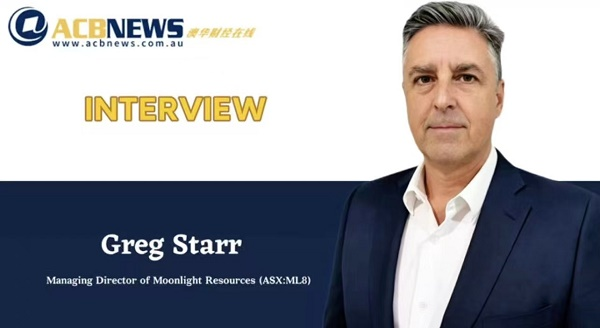
Managing Director Greg Starr told ACB News that the company is targeting completion of a maiden JORC Mineral Resource Estimate for Leo Grande by the end of September. Before then, Moonlight is advancing infill drilling, diamond drilling and metallurgical testwork — the technical workstreams needed to support the estimate.
Click here to watch the interview Video
For a junior explorer that raised A$10 million at its December 2025 IPO and carries a market value of about A$15 million, the investment case is beginning to shift. The question is no longer simply whether Leo Grande hosts gold, but how much gold can be converted into a formal resource — and what that could mean for Moonlight’s valuation.
Since listing, Leo Grande has moved from historical data review to more than 10,000 metres of systematic drilling. All 14 holes in the initial campaign intersected gold, while Phase 2 extended known mineralisation by 250 metres to the north-west and 200 metres to the south-east. As drilling continues to support the interpreted continuity between Leo Grande Central and South, the project is moving closer to becoming Moonlight’s first post-listing resource asset.
Terra Studio has also begun to frame the broader Clermont Gold Project in valuation terms. Its June report outlined a conceptual resource scenario of 402,600 ounces and, using peer-based metrics, estimated a potential enterprise value of about A$44 million for Moonlight Resources.
With the maiden MRE approaching, investor attention is shifting from exploration potential to resource scale, classification and valuation. Leo Grande’s ability to turn drilling momentum into a defined resource will be Moonlight’s most important post-listing value test.
Beyond the IPO Story: What Did Investors Really Buy?
Moonlight Resources listed in December 2025 after raising A$10 million at A$0.20 a share. At the time of writing, the stock was trading around A$0.16, implying a market capitalisation of roughly A$15 million.
The IPO offered exposure to a portfolio spanning gold, rare earths and uranium across more than 5,200 square kilometres. But from the outset, the Clermont Gold Project in central Queensland stood apart as the company’s priority asset, with Leo Grande emerging as the most advanced opportunity for near-term resource definition.
Leo Grande was not a blank-sheet target. Exploration dating back to the 1990s left behind 4,620 metres of historical drilling, including about 70 shallow reverse-circulation holes and evidence of a mineralised trend extending for roughly four kilometres.
The gold was evident. The scale was not.
The unresolved question was whether those historical intersections represented isolated zones or fragments of one larger, continuous shear-hosted system capable of supporting a maiden resource.
That uncertainty defined the IPO proposition. Moonlight came to market with credible targets and considerable geological upside, but without a quantified resource base against which investors could assess scale. ML8 was therefore priced as an early-stage explorer — attractive for its potential, but still lacking a resource anchor.
Since listing, Starr and his team have concentrated exploration at Leo Grande. The strategy has been direct: validate the historical database, close the gaps between existing holes, test continuity and build a geological model robust enough for resource estimation.
The significance of the new drilling is not simply that it keeps finding gold. It is that each result is tightening the geological picture. Leo Grande is beginning to look less like a collection of historical intercepts and more like a shallow, coherent and potentially scalable gold system.
For Moonlight, that is the inflection point: the moment geological promise begins to turn into something the market can measure, compare and price.
Reassessing Leo Grande: A Head Start on Resource Definition
Many newly listed explorers begin with little more than a geological thesis and the hope that drilling will turn theory into evidence.
Leo Grande starts further down that road — with a substantial historical database, broad near-surface mineralisation and the advantage of being located within an established mining region.
The Clermont Gold Project lies about 15 kilometres west of the town of Clermont in central Queensland, within reach of road, rail, power and water infrastructure. Across the broader region, projects such as Pajingo, Wirralie, Mount Carlton and Ravenswood reflect a long history of gold discovery, mine development and mining services.
The more immediate regional reference is GBM Resources’ Twin Hills Gold Project, about 120 kilometres away by road.
Twin Hills hosts a JORC Mineral Resource of 23.11 million tonnes at 1.3 g/t gold and 6.5 g/t silver, containing about 999,200 ounces of gold and 4.82 million ounces of silver. Roughly 60% of the resource is classified in the Measured and Indicated categories.
Twin Hills does not predict the outcome at Clermont. But it does provide a useful point of reference: central Queensland has already shown that gold systems of meaningful scale can be defined, advanced and placed on a credible development pathway.
Leo Grande itself is also far from a blank canvas. Historical exploration delivered about 70 shallow RC holes for a total of 4,620 metres and traced a mineralised trend extending for roughly four kilometres.
46m at 1.01 g/t Au from 6m
29m at 1.17 g/t Au from surface
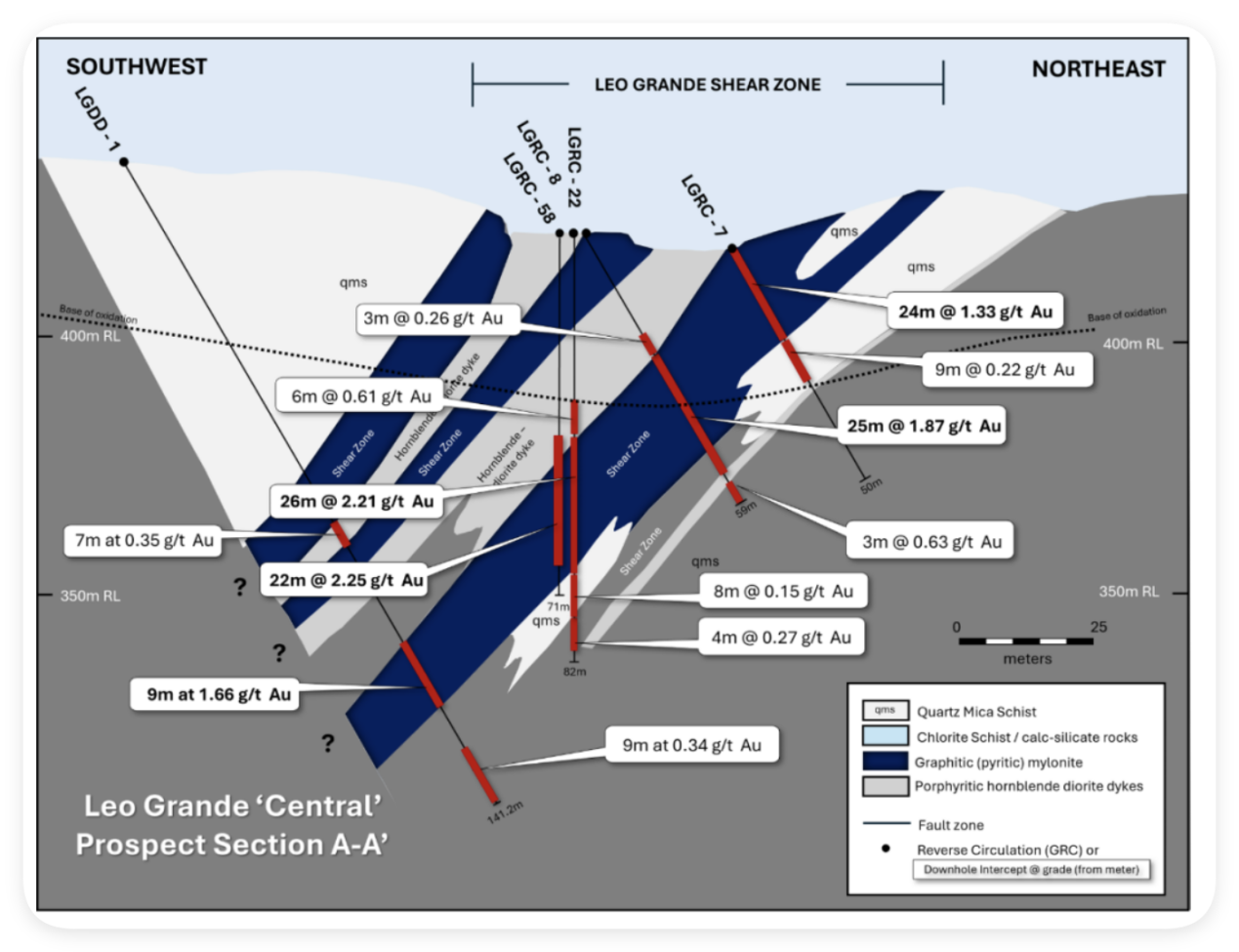
22m at 2.25 g/t Au from 40m
19m at 3.35 g/t Au from 34m
25m at 1.87 g/t Au from 26m
The historical drilling revealed broad, near-surface mineralisation controlled by a regional shear structure. Most holes were shallower than 140 metres, yet several remained mineralised at depth — leaving the system open both along strike and down dip.
That geometry is more than a geological detail. It is central to the project’s development appeal.
Terra Studio has argued that Leo Grande’s shallow position and oxide characteristics could support a lower-cost open-pit concept and a competitive processing route.
Those assumptions still need to be tested through metallurgy and formal studies, but the foundations are favourable: shallow mineralisation, accessible infrastructure and a mature regional mining ecosystem.
The historical database gave Moonlight a valuable head start. Its weakness was not a lack of gold, but the distance between the drill holes.
Wide spacing left too many gaps to establish continuity or support a formal resource estimate. Moonlight’s post-listing strategy has therefore been clear: tighten the drill grid, connect the mineralised zones and turn decades of geological evidence into a maiden JORC resource.
That is the real promise of Leo Grande — not simply that gold has been found before, but that the project may now be approaching the point where its scale can finally be defined.
From a 100% Hit Rate to 450 Metres of Extension
Moonlight completed its first post-listing RC campaign in December 2025 and reported the results the following month. All 14 holes, covering 940 metres, intersected gold mineralisation.
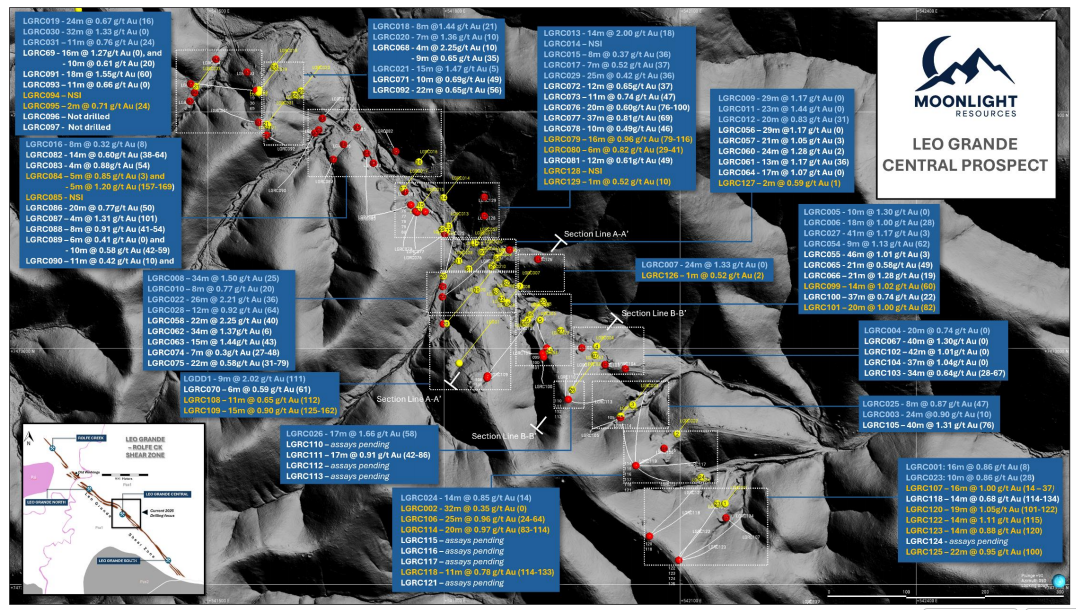
Key results included 40 metres at 1.30 g/t gold from surface in LGRC067; 34 metres at 1.37 g/t from six metres in LGRC062, including 10 metres at 2.52 g/t; 24 metres at 1.28 g/t from two metres in LGRC060; and 21 metres at 1.28 g/t from 19 metres in LGRC065.
LGRC067, LGRC062 and LGRC065 all ended in mineralisation, indicating that the system remained open in those directions.
If the first campaign validated the historical picture, Phase 2 — launched in February 2026 — was designed to test how far the system might extend.
Results released on May 7 showed 42 metres at 1.01 g/t from surface in LGRC102 and 40 metres at 1.31 g/t from 76 metres in LGRC105, including five metres at 3.40 g/t, on the south-eastern extension. To the north-west, LGRC092 returned 18 metres at 1.55 g/t from 60 metres, including three metres at 7.80 g/t.
The programme extended known mineralisation by 250 metres to the north-west and 200 metres to the south-east. It also strengthened Moonlight’s interpretation that the Leo Grande Central mineralised zone may continue along the shear towards Leo Grande South, where historical drilling had already identified mineralisation.
In June, Moonlight reported assays from a further 22 RC holes covering 2,683 metres. Results included 20 metres at 1.00 g/t from 82 metres in LGRC101; 22 metres at 0.95 g/t from 100 metres in LGRC125, including nine metres at 1.41 g/t; 15 metres at 1.08 g/t from 100 metres in LGRC120; and 14 metres at 1.11 g/t from 115 metres in LGRC122, including four metres at 2.22 g/t.
The latest results continued to test the south-eastern extension of Leo Grande Central and added density to the drill grid. Moonlight said mineralised thickness and grade were showing encouraging continuity across multiple sections, while several deeper holes ended in mineralisation.
By June, the expanded Phase 2 programme had reached about 10,000 metres, with further assays still pending. The growing dataset is doing more than adding metres: it is narrowing the uncertainty around the geometry, continuity and scale of the system.
Starr captured the point in an interview with ACB News: “This is a growing system where individual results are less important than the collective results.”
The Inflection Point: From Discovery to Resource Definition
Leo Grande is now moving beyond historical validation and into the technical work required for a maiden resource estimate.
The market’s focus is shifting with it — from whether the project contains gold to how much of that gold can be classified, quantified and ultimately valued.
Moonlight’s June update said Phase 2 drilling was testing continuity between Leo Grande Central and South, extending the system along strike and at depth, and increasing drill density to support a future MRE.
Starr told ACB News that the company is targeting completion of the maiden MRE by the end of September 2026.
To get there, Moonlight is advancing three parallel workstreams: tighter-spaced drilling, diamond drilling and metallurgical testwork. Samples have already been sent to the laboratory, with the results expected to inform the project’s processing assumptions.
The company is also planning to begin a conceptual mining project study alongside the MRE. The aim is to test what a future development could look like at the scale currently being defined — including potential mining configuration and commercialisation options.
That matters because Moonlight is not treating the MRE as the end of exploration. It is positioning the estimate as the bridge between geology and development.
Terra Studio’s June report reached a similar conclusion, forecasting a maiden MRE in the third quarter and a possible resource update in the fourth quarter, followed by scoping work.
If that timetable holds, the third quarter will mark Moonlight’s first formal resource-pricing event.
The next phase — metallurgy, resource expansion and early study work — could begin to move the market from valuing ounces in the ground to considering how those ounces might one day be developed.
Valuation Frameworks Begin to Take Shape
As Leo Grande moves through historical data validation, strike extension and tighter drilling, the market is beginning to look beyond geology and towards valuation.
Two publicly available studies now provide the clearest reference points: Foster Stockbroking’s March Lunch-Time Bites note and Terra Studio’s June research report.
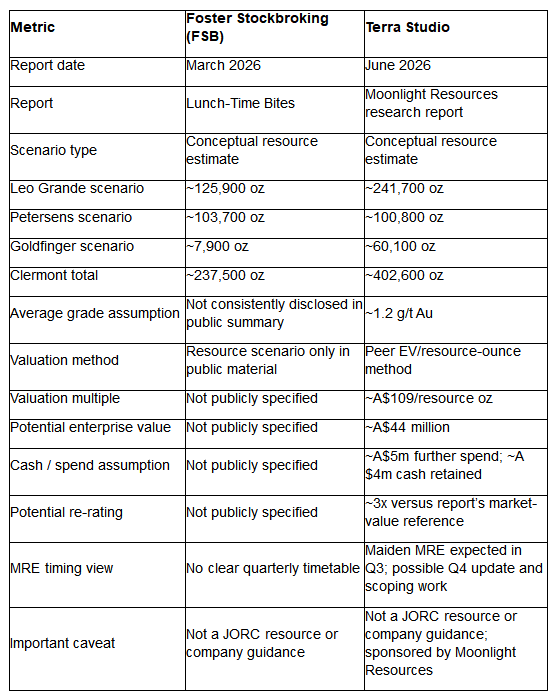
FSB was the first to suggest that Clermont could support a conceptual gold inventory of more than 200,000 ounces. Its model estimated 237,500 ounces across three targets — about 125,900 ounces at Leo Grande, 103,700 ounces at Petersens and 7,900 ounces at Goldfinger.
Terra Studio later revisited the project using the latest drilling results and arrived at a more ambitious scenario.
It estimated 241,700 conceptual ounces across Leo Grande North, Central and South. Adding about 100,800 ounces at Petersens and 60,100 ounces at Goldfinger lifted the broader Clermont scenario to approximately 402,600 ounces at an average grade of about 1.2 g/t gold.
Terra Studio then applied a peer-derived valuation multiple of roughly A$109 per resource ounce. On that basis, it estimated a potential enterprise value of about A$44 million for Moonlight Resources under the 402,600-ounce scenario.
The report also assumed Moonlight could spend about A$5 million on further exploration and retain roughly A$4 million in cash. Against the market value used in its analysis, Terra Studio concluded that the company offered about three times potential re-rating upside.
These figures are not JORC resources and they are not company guidance. They are third-party conceptual models. Terra Studio also disclosed that its report was sponsored by Moonlight Resources. That does not remove the model’s usefulness, but it makes the maiden MRE the decisive test.
The significance of the two studies is not that they settle the valuation debate. It is that they begin to frame it.
FSB placed Clermont at about 237,500 ounces. Terra Studio lifted the conceptual case to about 402,600 ounces. The market is now waiting to see where the first formal resource estimate lands between expectation and evidence.
Clermont Gold Project: Third-Party Resource and Valuation Scenarios
Conclusion: A Defining Quarter for Moonlight
Moonlight’s most important shift since listing is not any single drill result. It is the gradual conversion of Leo Grande from a collection of historical mineralised intersections into a potentially measurable and priceable resource asset.
From a 4,620-metre legacy database to more than 10,000 metres of modern drilling, the company has built a clearer picture of a shallow system extending along the Leo Grande shear.
Third-party research has begun to attach numbers to that potential. The maiden MRE will now decide how much of the story survives formal resource estimation.
With further assays, metallurgical results and diamond drilling progressing ahead of the September target, the third quarter is set to become Moonlight’s most important value-verification period since listing.
For Leo Grande, the next milestone is no longer another promising intercept. It is a resource the market can finally measure.
Disclaimer: This article is for information only and does not constitute investment advice. Early-stage mineral exploration companies carry significant geological, technical, funding and market risks. Investors should refer to Moonlight Resources’ official ASX announcements and JORC-compliant disclosures before making any investment decision.

相关阅读


免责声明:本网站信息仅供一般参考,不构成投资或财务建议。虽力求准确与完整,但不保证信息的准确性、完整性或时效性。投资有风险,决策前请咨询专业独立顾问。使用本网站即视为接受本免责声明。
热门点击
-
- 【公司观察】百年金矿重焕生机 Theta Gold Mines(ASX:TGM)610万盎司黄金资源开发提速 2027年首金进入倒计时
-
- 【异动股】股价自低位反弹200% Nagambie Resources(ASX:NAG)金锑矿资源扩量前景引关注
-
- 【10.13】今日财经时讯及重要市场资讯
-
- 澳储行纪要:15年利率新高背后 澳洲通胀的“内因”正在扩大
-
- PLS Pilgangoora锂矿所含锂储量增长31% 首次确立4650万吨地下矿石储量 露天矿可支持约20年生产
-
- Lithium Plus Minerals(ASX:LPM)Lei锂项目环评审批进入实质性推进阶段 DSO范围研究临近收官
-
- “脏钱”过境 澳洲12万亿房地产市场展开监管围堵 4.5万家企业强制注册后反洗钱防线能否真正前移?
-
- 【周初要闻汇总】中国经济数据牵动澳洲资源股 中澳经贸合作与贸易摩擦并存 澳洲金融及矿业并购引关注
-
- 【10.19】今日财经时讯及重要市场资讯
-
- 【10.16一周重大新闻及事件回顾】澳洲就业与税制改革牵动市场 全球通胀及AI板块波动引关注
-
- 法国大规模示威演变为暴力冲突 生活成本与公共服务问题引发关注
-
- 【10.19】澳股午评 并购题材与能源股支撑大盘 科技及锂板块承压 ASX200午间小幅走高
-
- Flagship Minerals(ASX:FLG)矿权扩容 加拿大Whipsaw 铜矿项目占地面积扩大约132%至66平方公里
-
- Antilles Gold(ASX: AAU)古巴资产解锁出现实质进展 GEM启动美国资本入股方案